Is Beef Tallow Good for Your Skin? Yes, But Here's the Problem
Beef tallow is genuinely good for your skin. The science backs it up. But somewhere between "great raw material" and "product you put on your face," something went wrong with most tallow skincare.

Why "Pure" Beef Tallow Isn't Enough: The Science Your Skin Actually Needs
Beef tallow is having a moment. Scroll through any ancestral health forum or "clean beauty" corner of Instagram and you'll find passionate advocates swearing by this old-school ingredient.
And honestly? They're not wrong. At least not about the ingredient itself.
Tallow is genuinely good for your skin. The science backs it up. But somewhere between "great raw material" and "product you put on your face," something went terribly wrong with most tallow skincare on the market.
Let's break down why tallow works, why most "pure" tallow products fail to hydrate, and what actually makes a moisturizer effective.
Why Tallow Actually Works
Here's what the tallow evangelists get right: beef tallow is remarkably compatible with human skin.
Your skin produces its own moisturizer called sebum, an oily, waxy substance that lubricates and waterproofs your skin. Fun fact: the word "sebum" literally comes from the Latin word for tallow. According to Merriam-Webster, the term entered medical use around 1728, borrowed from Latin sēbum meaning "tallow, grease."
They named our skin's natural oil after rendered animal fat because the two are so chemically similar.
This isn't just etymology trivia. Both tallow and human sebum share a similar fatty acid profile.
- Human Sebum: Dominated by triglycerides (57%), wax esters (26%), and squalene (12%).
- Beef Tallow: Primary fatty acids are Oleic (37-43%), Palmitic (24-32%), and Stearic (20-25%).
Because this composition closely mirrors the fatty acid building blocks of your skin, your body recognizes it as "familiar" rather than foreign.
A 2024 scoping review published in the National Library of Medicine examined 19 studies on tallow and found evidence supporting its biocompatibility, hydration benefits, and even therapeutic effects for dermatitis. Furthermore, research in the International Journal of Cosmetic Science confirms that lipids structurally similar to human sebum have better bioavailability and reduce irritation.
So yes, tallow is a legitimately good skincare ingredient. Full stop.
The Problem with "Pure" Tallow Skincare
Here's where things fall apart.
Walk into a farmer's market or browse Etsy and you'll find dozens of "100% tallow" moisturizers. The marketing implies that purity equals quality, that the less you mess with it, the better.
That is not how skincare formulation works.
Straight tallow is a phenomenal raw material but a mediocre final product. It is greasy, it can smell, and while it contains beneficial lipids, it is missing critical components your skin needs to actually hydrate.
To understand why, you need to understand the three mechanisms of moisture.
Why Tallow Alone Just Sits There
Dermatologists and cosmetic scientists categorize moisturizing ingredients into three distinct classes (as detailed in the Journal of the German Society of Dermatology):
- Humectants: These attract and bind water to your skin like a magnet. (Think Glycerin or Hyaluronic Acid).
- Emollients: These soften and smooth skin by filling gaps between cells. (Tallow is here).
- Occlusives: These create a physical seal to stop water from evaporating. (Tallow is here too).
The Critical Flaw: Tallow is an emollient and an occlusive, but it is not a humectant.
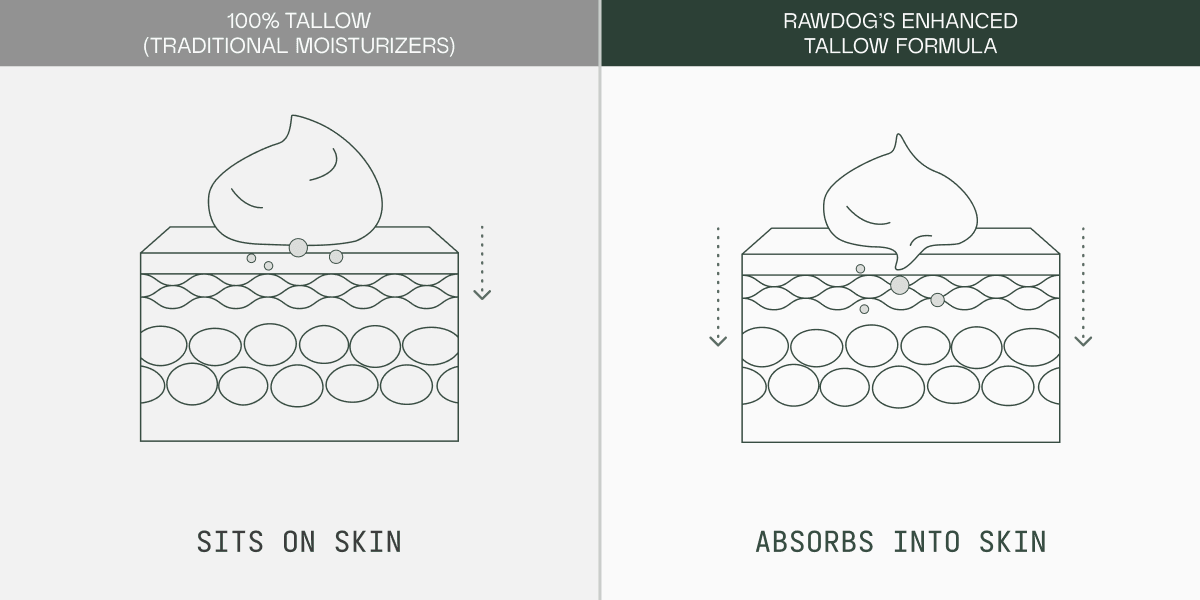
It can prevent moisture loss, and it can soften your skin, but it doesn't actively pull hydration into your skin. When you apply straight tallow, it forms a greasy layer that sits on top. It's not hydrating from within; it's just sealing over whatever dryness already exists.
This is why so many people try tallow balms and end up feeling like a glazed donut: shiny and slick on the surface, but dry and tight underneath.
What Your Skin Actually Needs: "NMF"
Your skin has a sophisticated hydration system built right into it called the Natural Moisturizing Factor (NMF).
NMF is a cocktail of amino acids, sugars, and organic acids that live inside your skin cells. Scientists distinguish between "free water" (wetness) and "bound water" (hydration). Research in the Journal of Cosmetic Science shows that only "bound water" (water held in place by NMF) gives skin its elasticity and plumpness.
Key NMF components include:
- Amino Acids: Glycine, Serine, Alanine (approx. 40% of NMF).
- PCA (Pyrrolidone Carboxylic Acid): The most powerful water-magnet in your skin.
- Lactate: The same stuff that makes muscles burn keeps skin plump.
- Urea: A crucial moisture binder.
Tallow contains zero NMF components.
It can't actively hold water in the skin cells. This is the fundamental flaw of every "pure tallow" moisturizer on the market.
The Ceramide Factor: Bricks and Mortar
Your skin barrier is often compared to a brick wall. The cells are the bricks, and the "mortar" holding them together is made of cholesterol, fatty acids, and ceramides.
If you lack ceramides, the mortar crumbles, and the wall (your skin barrier) fails. This leads to eczema and severe dryness.
However, not all ceramides are equal. Your skin uses a very specific molecular structure (the 2S, 3S, 4R configuration). Most cheap ceramides are synthetic approximations that don't fit the lock.
We rely on clinical data regarding bio-identical ceramides. In a controlled study, researchers found that while standard moisturizers stopped working quickly, formulations with bio-identical ceramides maintained significantly elevated hydration levels for 6 days after the last application.
Think about that. Six days of residual hydration from a properly formulated ceramide, versus tallow that works only as long as it sits on your face.
How We Solved This at RAWDOG
We love tallow. We think it's one of the best ingredients available, especially grass-fed tallow with its naturally occurring Vitamins A, D, E, and K.
But we'd never sell you straight tallow and call it a moisturizer. That would be lazy formulation.
Instead, we engineered a formula that uses tallow for what it's good at (barrier support and nutrient delivery) while adding exactly what it's missing.
1. Natural Moisturizing Factors (The Humectants)
We added the exact molecules found in your skin's internal hydration system:
- Sodium PCA: Binds 1.5x its weight in moisture (See safety assessment here).
- Sodium Lactate & Urea: To improve texture and bind water.
- Amino Acid Complex: Serine, Glycine, Alanine, and Proline to fuel the skin cells.
2. Skin-Identical Ceramides
We use Ceramide NP produced through biofermentation. It is an exact stereochemical match to your skin, providing that long-term barrier repair that fat alone cannot achieve.
3. Smart Emulsion Technology
We use olive-derived emulsifiers that create lamellar liquid crystalline structures. These mimic the organizational pattern of your skin's own lipids, allowing the formula to absorb deeply rather than sitting on top like a greasy film.
4. Clean Preservation
No parabens. No formaldehyde releasers. We use a system based on Caprylhydroxamic Acid, which is proven safe and effective without nuking your skin's microbiome.
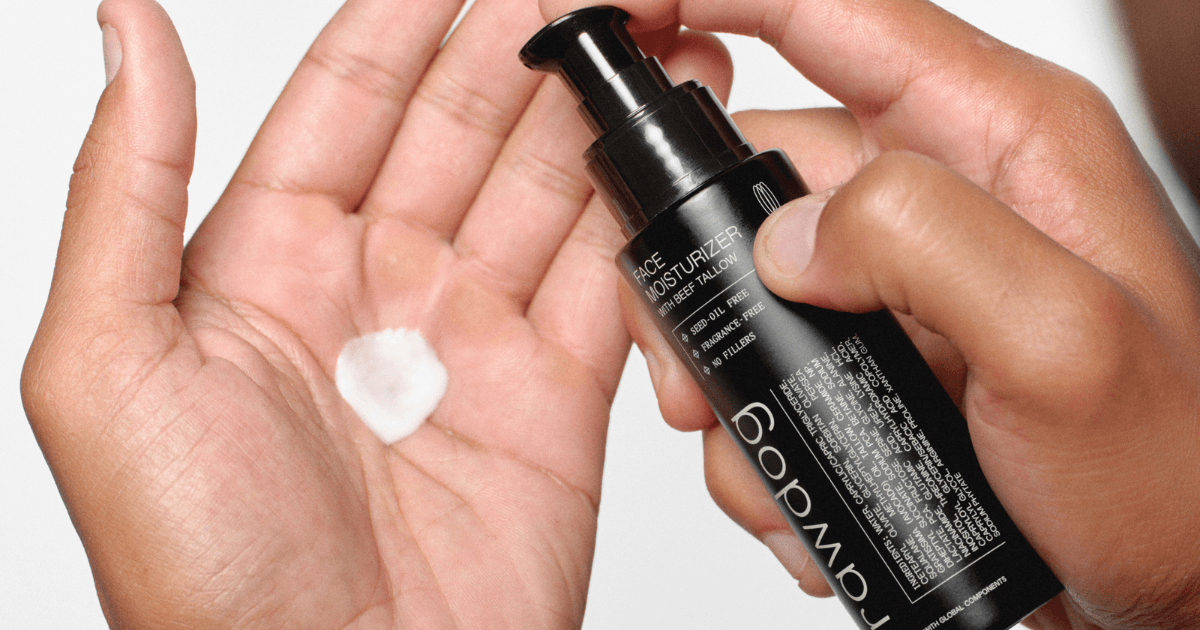
Check out the Face Moisturizer with Beef Tallow →
Pure Tallow vs. Engineered Tallow
| Factor | Pure Tallow Balm | RAWDOG Moisturizer |
|---|---|---|
| Humectants (Water Magnets) | ❌ None | ✅ Full NMF complex |
| Emollients (Softeners) | ✅ Yes | ✅ Yes, plus Squalane & Avocado |
| Occlusives (Sealers) | ✅ Yes | ✅ Yes |
| Ceramides | ❌ None | ✅ Skin-identical Ceramide NP |
| Absorption | Sits on surface | Penetrates and absorbs |
| Skin Feel | Greasy, heavy | Lightweight, matte |
| Mechanism | Passive barrier only | Active hydration + barrier |
| Residual Benefits | Gone when washed off | Sustained hydration |
The Bottom Line
Beef tallow is good for your skin. The science is clear on that.
But "good ingredient" doesn't automatically mean "good product." A pile of high-quality lumber isn't a house. A cabinet full of great ingredients isn't a meal.
Pure tallow products give you 2 out of 3 essential moisturizing functions. They lack the humectants that bind water and the ceramides that repair the barrier.
If you've tried tallow skincare before and found it greasy, smelly, or underwhelming, that's not tallow's fault. That's lazy formulation dressed up as "purity."
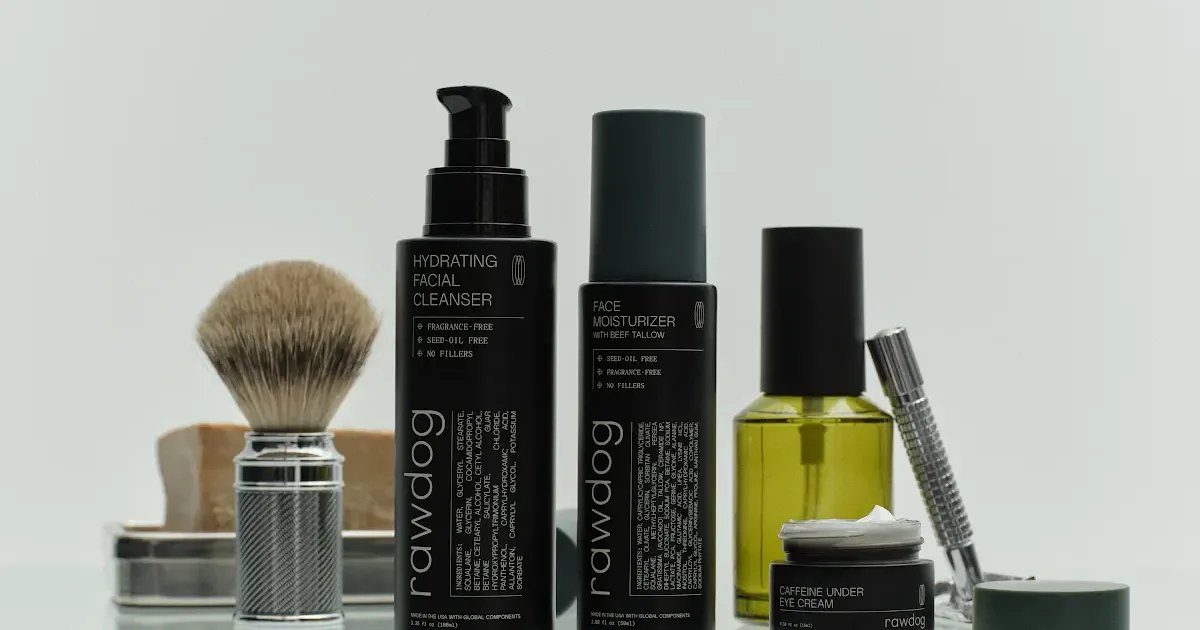
For the broader ingredient picture, see how popular men’s skincare sets compare.
You deserve better. Your skin deserves a product that was actually engineered to work.
Try the Face Moisturizer with Beef Tallow →
RAWDOG is the first completely seed oil-free men's skincare brand. Our formulations are built on ancestral ingredients like grass-fed beef tallow, enhanced with modern cosmetic science to actually work. No seed oils. No compromises. Just results.